

The Development of Market Bubbles and the Challenges of AI
The relationship between psychology and financial markets is complex. Historical events highlight numerous occasions when irrational beliefs drove markets to astonishing peaks, only to subsequently collapse after crucial incidents.
This phenomenon is known as a ‘bubble,’ similar to the life cycle of a soap bubble – growing exuberantly and eventually bursting.
Markets ideally reflect the collective wisdom of millions of participants who evaluate various assets.
This understanding is rooted in:
- Supply and demand – guiding price discovery;
- Asset liquidity – allowing smooth transactions without major price fluctuations; and
- Market efficiency – enabling quick asset repricing with new information.
Throughout history, we have witnessed multiple market manias where asset prices became severely divorced from their true value. These bubbles are among the most analyzed phenomena in economic history, yet they keep recurring.
The fascination with bubbles arises not only from their dramatic rise and inevitable fall but also from the remarkable consistency of the psychological forces fueling them.
From 17th Century Amsterdam to 21st Century New York, strikingly similar patterns emerge: new innovations excite the market, prices rise, and an overwhelming greed for success takes hold.
Market participants continuously develop valuation justifications, anchored in the belief that ‘This time it’s different.’
History, however, has repeatedly demonstrated otherwise.
Tulip Mania
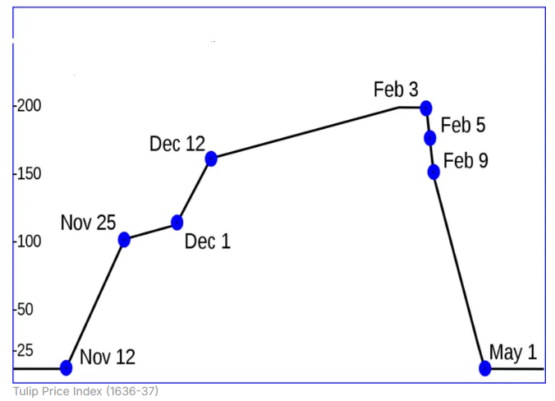
Dating back to 1636 in the Netherlands, a virus caused tulip bulbs (yes, the flower) to display vibrant new colors and patterns, captivating wealthy merchants and leading to massive speculation in the tulip bulb market.
Tulips became symbols of wealth and prestige, previously viewed as exotic imports from the Ottoman Empire. The excitement inflated prices to levels comparable to homes in Amsterdam.
Trading predominantly occurred through rapidly changing futures contracts, while actual tulip bulbs remained hidden in their fields.
The psychological narrative was understandable. Investors collectively assured themselves that the asset’s rarity guaranteed lasting value. With exclusivity and limited supply, rising prices seemed unavoidable. Buyers viewed this as a secure investment in a prosperous market, not mere speculation.
The mania abruptly ended when an auction for tulips drew no bidders, triggered by a sudden agreement that the soaring prices were unsustainable.
Source: Corporate Finance Institute
The image above visually depicts price fluctuations during Tulip Mania, referencing the Tulip Price Index.
The South Sea Bubble
More than a century later, a similar event occurred in 1720 London, where a company, supported by the government, engineered what many regard as the world’s first Ponzi scheme.
The South Sea Company was formed as a public-private partnership tasked with managing Britain’s national debt in exchange for exclusive trading rights in the Spanish-controlled Americas.
Public enthusiasm soared as Britons expected to replicate the East India Company’s success in the Americas’ slave trade, despite Britain lacking control over the region.
The Spanish limited access, preventing the South Sea Company from realizing any genuine profits. Nevertheless, the illusion of prosperity thrived in London, with the company continuously issuing new shares in exchange for more government debt.
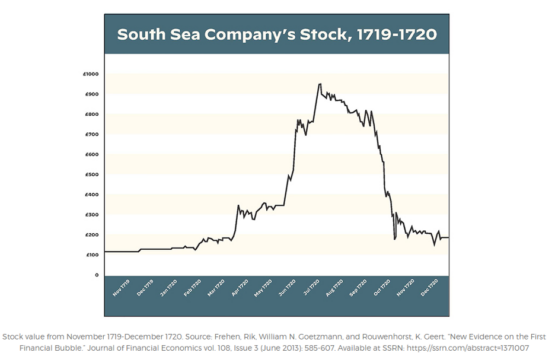
The share price skyrocketed from £120 to nearly £1,000 in just months. When confidence waned later that year, the price plummeted back to £120, wiping out fortunes—including that of Sir Isaac Newton, who lost the equivalent of £4 million today.
While the background was more intricate, the psychological dynamics echoed previous bubbles. With government backing, royal endorsement, and exclusive trading rights in a thriving market, investors were led to believe that all risks had been mitigated and profits were guaranteed.
Once again, the market rationalized these developments, convincing itself that this was not speculation.
Source: Journal of Financial Economics
The Dot-Com Bubble
Fast forward to the modern era, about 12 years after the internet became commercially viable, giving rise to e-commerce businesses as the latest market sensation.
Startups with little more than a domain name and big dreams eagerly sought listings on the Nasdaq, attracting investors ready to support these visions.
Similar to the South Sea Company, many of these companies quickly burned through the cash they raised for expansion.
The reality of the dot-com bubble was that many of these firms lacked a feasible path to achieve free cash flow.
Traditional valuation metrics, such as price-to-earnings (PE) ratios, were deemed outdated due to the internet’s transformative nature.
Analysts invented new metrics, such as “price to clicks” and “price to eyeballs,” to explain the inflated valuations.
Ample funding in the US allowed the frenzy to continue for nearly five years until, inevitably, capital began to dry up, and the confidence that propelled the surge faded.
Though from a different era, the psychological patterns remained strikingly similar.
Undoubtedly, the internet has been one of the most transformative advancements of our time, changing media, communication, and commerce.
The desire to capitalize on this revolution early, while assuming it would guarantee lasting wealth, was misguided. While the technology itself, along with the adoption of e-commerce, was genuinely revolutionary—as seen with Amazon’s success—the notion that every single e-commerce company would achieve monumental success was yet another significant error in investor judgment. Just ask anyone who invested in Pets.com.
Subprime Mortgages and the Global Financial Crisis
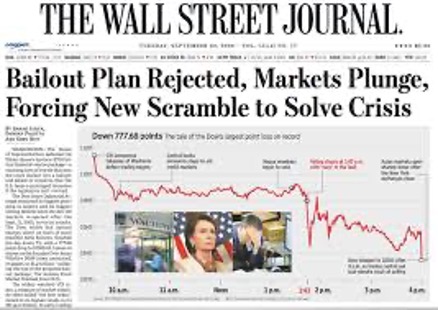
The most documented event, the global financial crisis, arose from reckless lending practices and complex derivative products that excessively inflated the US housing market, based on the belief that prices could only ever go up.
US banks crafted and sold intricate mortgage products to consumers who were financially unable to manage repayments. They subsequently bundled these low-grade financial assets into mortgage-backed securities and collateralized debt obligations, marketing them to global investors as AAA-rated instruments, claiming that risk had been adequately diversified.
To the public, confidence in the US housing market seemed unshakeable, a sentiment bolstered by institutional and federal support.
Just as with tulip bulbs and internet companies, US housing prices began to fall, and mortgage borrowers started defaulting on their payments, signaling the onset of a market collapse.
The belief that the system could not fail was once again fundamentally flawed.
This time, investors across all sectors felt the impact, as major banks like Lehman Brothers went bankrupt and millions of families lost their homes to foreclosure.
Source: Author-provided
Upon reviewing centuries of market bubbles, a clear pattern emerges.
Looking ahead to 2026, could artificial intelligence (AI) be the next bubble?
Speculative narratives suggest it could be, yet the stability of major AI players tells a different story.
Tech giants like Nvidia, Alphabet, and Meta have witnessed their stock prices surge rapidly. Recently, skepticism has begun to permeate the sector, as the market weighs similar concerns.
The pivotal difference for big tech lies in the tangible earnings these companies showcase.
Recent earnings reveal impressively solid fundamentals and sustained demand, rather than mere speculative assurances:
- Nvidia reported $57 billion in revenue in Q3 2025, with nearly 90% derived from data-center AI chips.
- Alphabet’s Q4 2025 revenue was $113.8 billion, an 18% rise year-on-year, largely propelled by a remarkable 48% increase in Google Cloud.
- Meta Platforms recorded $59.9 billion in revenue for the same period, marking a 24% year-on-year growth, bolstered by strong advertising and AI-powered ad tools.
- Amazon achieved an impressive $213.4 billion in revenue in this period, reflecting a 13.6% year-over-year increase, with Amazon Web Services contributing 17% to that total.
These impressive revenue figures continue to roll in, even as these companies aggressively project increased capital expenditure for future growth.
For these firms, margins remain healthy while generating strong free cash flows.
This shift has moved the focus away from ‘price to clicks,’ centering instead on companies with established advantages, solid balance sheets, and significant intellectual property over their competition.
Yet, valuation assessments still evoke unease.
According to FactSet data, Nvidia trades at a notable 41x forward earnings, whereas peers like Amazon and Meta trade at comparatively more modest 26x and 22x forward PE, respectively—a discount compared to the broader S&P 500, which currently trades at 28x forward PE.
Importantly, the AI market should not be generalized. Certain segments appear much more concerning and exhibit distinct characteristics apart from big tech.
Consider Palantir Technologies, an AI software firm that has captured the attention of many speculative investors—currently trading at a staggering forward PE of 102x. This reflects a bet on perfection, and any disappointment in growth expectations would severely impact investors.
Palantir is not isolated; numerous smaller AI companies exhibit similar traits, often while remaining significantly unprofitable. Once again, the narratives justifying these valuations echo those of prior bubbles…
This time it’s different…
The reality may indeed be different this time. Perhaps they could be correct.
To reiterate, psychology in financial markets remains a complex field. The same greed that fueled historical bubbles is still prevalent—possibly even more so today.
Markets can manifest rational and irrational behavior simultaneously, making it crucial to position oneself carefully.
The answer to the question is both yes and no. Big tech possesses the earnings, balance sheets, and ability to justify lofty valuations; however, the speculative corners of the AI market include loss-making companies trading at untenable valuations.
AI is hailed as the most significant technological advancement since the internet, with the potential to transform industries and impact lives. History shows us that remarkable innovations have emerged before, often prompting markets to exhibit similar exuberance.
Amidst it all, reflecting on the hard-earned lessons of the past remains crucial. Not every company will thrive in this sphere, and fundamentals continue to matter. This is a pattern that history has taught us to trust.
Uvaal Singh is a portfolio manager at Sasfin Wealth.
Moneyweb does not endorse any products or services being advertised in sponsored articles on our platform.


